Why Quitting Smoking Is So Hard (The Science)
Medical Disclaimer
This article is for informational purposes only and does not constitute medical advice. Always consult a healthcare professional before making changes to your health routine. If you're experiencing a medical emergency, call 911 or your local emergency number.
Read our full medical disclaimer →Why Quitting Smoking Is So Hard (The Science)
If you’ve ever tried to quit smoking and failed, you probably blamed yourself. Willpower. Discipline. Motivation. You told yourself you just didn’t want it enough. Here’s what the neuroscience actually says: you were fighting one of the most sophisticated addiction mechanisms in pharmacology, and the odds were stacked against you before you even started.
Nicotine addiction isn’t a character flaw. It’s an engineered neurochemical trap. Once you understand the machinery, you’ll stop blaming yourself and start building a strategy that actually accounts for what your brain is doing.
The 10-Second Hijack
Let’s start with speed, because speed is everything in addiction.
When you take a drag on a cigarette, nicotine reaches your brain in approximately 7-10 seconds. That’s faster than an intravenous injection. The smoke hits your lungs, nicotine crosses the ultra-thin alveolar membranes into your bloodstream, and the arterial system delivers it to your brain almost instantly.
Why does speed matter? In the neuroscience of addiction, the faster a substance delivers its reward, the more addictive it becomes. This is why smoking crack is more addictive than snorting cocaine. Same drug, faster delivery. Nicotine via cigarette smoke has one of the fastest delivery systems of any commonly used drug.
Each cigarette delivers roughly 1-2 mg of nicotine (out of the 10-14 mg in the tobacco itself; most is burned off). A pack-a-day smoker is delivering approximately 200-400 individual nicotine boluses to their brain per day. Each one reinforces the addiction.
How Nicotine Rewires Your Reward System
To understand why quitting is so hard, you need to understand what nicotine is doing inside your brain. Think of it in three stages.
Stage 1: The Dopamine Flood
Nicotine binds to receptors called nicotinic acetylcholine receptors (nAChRs), specifically the alpha-4 beta-2 (α4β2) subtype in your brain’s reward pathway. These receptors are like locks, and nicotine is a key that fits perfectly.
When nicotine turns these locks, it triggers a cascade of neurotransmitter releases. The most important one is dopamine, your brain’s reward currency. Nicotine triggers dopamine release in the nucleus accumbens, the brain’s pleasure center, at levels 150-200% above baseline.
To put that in perspective:
- Natural rewards like food and sex push dopamine roughly 50-100% above baseline
- Exercise lands in a similar range
- Nicotine hits 150-200%, reliably and in under 10 seconds
- Cocaine can spike it higher, but most people don’t use cocaine 200 times a day
Nicotine’s dopamine boost isn’t the biggest in pharmacology, but it’s big enough to powerfully rewire behavior, especially given how frequently it’s administered.
Stage 2: Receptor Upregulation (Your Brain Adapts)
Here’s the part most people get wrong. They think the problem is that nicotine feels good. But the real trap is what happens after the initial pleasure fades.
Your brain doesn’t like being overstimulated. When nicotine keeps flooding your receptors with signal, your brain responds by growing more receptors, a process called upregulation. Research published in Biological Psychiatry has shown that chronic smokers have 50-100% more nAChRs than non-smokers.
Think of it like this: imagine you’re in a room with a speaker blasting music. To compensate, you grow more ears. Now, when the music stops, all those extra ears hear the silence even more intensely.
That’s what happens when nicotine levels drop. All those extra receptors are empty, unstimulated, and sending distress signals to your brain. This is the physical basis of withdrawal. It’s why “just not smoking” feels so much worse for a smoker than it does for someone who never started.
Stage 3: The New Baseline (Dependence)
After weeks or months of regular nicotine use, your brain has fundamentally recalibrated. Your new “normal” requires nicotine just to feel okay. Without it, you feel:
- Anxious and irritable for no clear reason
- Unable to focus on even simple tasks
- Flat and joyless, a state researchers call anhedonia
- Physically restless, like your skin doesn’t fit right
This is the cruelest trick of nicotine addiction: smoking doesn’t make you feel better than normal. It relieves the withdrawal it created. The “relaxing” cigarette isn’t adding calm. It’s temporarily silencing the anxiety that nicotine dependence generated. Non-smokers feel that baseline calm all the time, for free.
The Bottom Line: Nicotine addiction rewires your brain in three steps: dopamine reward, receptor upregulation, and baseline shift. By the time you’re physically dependent, you need nicotine just to feel how you felt before you ever started smoking.
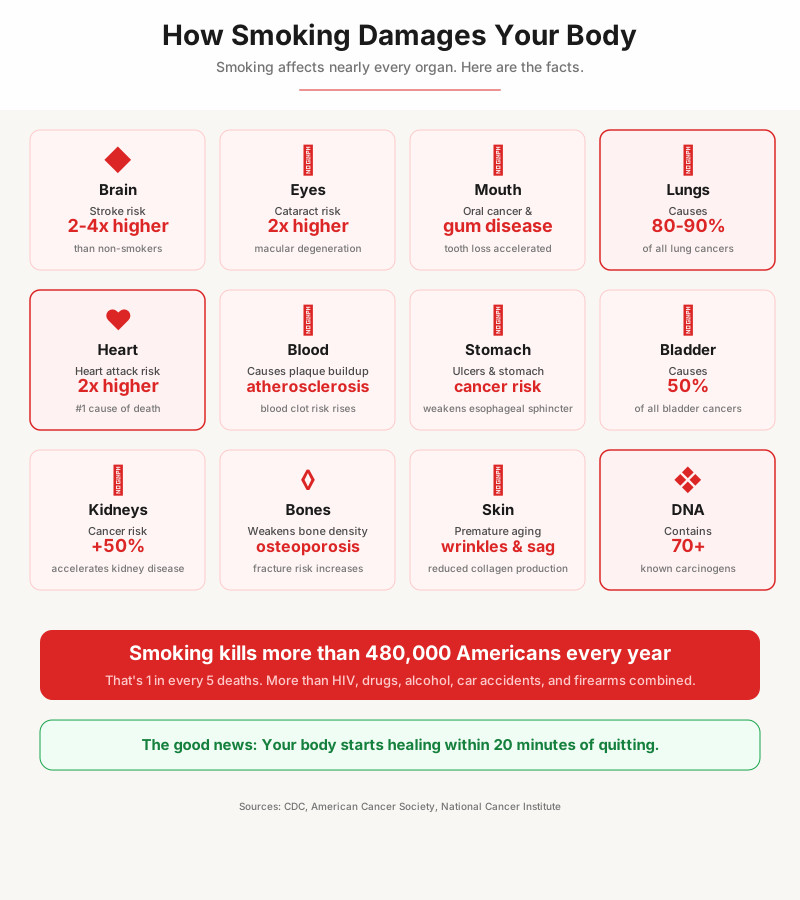 How smoking damages your body. Sources: U.S. Surgeon General’s Report, 2014; CDC; American Cancer Society
The Secret Weapon in Cigarettes: MAO Inhibitors
Here’s something that surprises most people: nicotine alone is significantly less addictive than cigarette smoking. And the reason has nothing to do with nicotine itself.
Tobacco smoke contains chemicals called harmala alkaloids that act as monoamine oxidase inhibitors (MAOIs). MAO is the enzyme your brain uses to break down dopamine, serotonin, and norepinephrine. When you inhibit MAO, these neurotransmitters stick around longer.
PET scan studies published in Proceedings of the National Academy of Sciences found that smokers have 30-40% lower MAO-A and MAO-B levels than non-smokers. This means that when nicotine triggers a dopamine release, the dopamine lingers far longer than it would from nicotine alone, because the cleanup enzyme has been partially disabled.
This is one reason why:
- Nicotine replacement therapy (patches, gum, lozenges) produces noticeably milder cravings than cigarettes, even at matched nicotine doses, because it skips combustion entirely
- Vapers who switch from cigarettes often find vaping less satisfying than expected, since vaping lacks the full MAOI effect of combustion
- Cold turkey from cigarettes is uniquely brutal compared to quitting other nicotine forms, the MAOI withdrawal compounds the nicotine withdrawal
The tobacco plant didn’t evolve these chemicals to addict humans, but the combination creates a pharmacological one-two punch: nicotine provides the dopamine surge, and MAO inhibition makes it last longer and hit harder.
The Habit Loop: Your Other Addiction
Physical dependence is only half the story. The other half is behavioral conditioning, and in some ways, it’s even harder to break.
Psychologist Charles Duhigg popularized the concept of the habit loop: cue, routine, reward. For smokers, this loop is deeply ingrained:
- Cue: morning coffee, finishing a meal, work stress, getting in the car, alcohol, a long phone call, boredom
- Routine: stepping outside, the physical ritual of lighting up and holding the cigarette, the conscious act of separating from whatever you were doing
- Reward: the nicotine hit, a few minutes of sanctioned pause, a brief sense of control
A pack-a-day smoker performs this loop approximately 7,300 times per year. After a decade of smoking, that’s 73,000 repetitions of the same cue-routine-reward cycle. Few habits in human experience are reinforced this many times.
This is why smokers who have been quit for months or even years can be suddenly blindsided by a powerful craving. The physical dependence is long gone, but the habit loop is etched into their neural circuitry. Walking past their old smoke break spot. The smell of someone else’s cigarette. Pouring that first cup of coffee. These environmental cues activate a learned neural pathway that says: this is when we smoke. To understand how long these cue-triggered cravings actually last in the moment, the answer is shorter than most people expect.
Why Habits Are So Persistent
Habits are encoded in the basal ganglia, a brain region that operates largely below conscious awareness. Unlike conscious decisions (which require the prefrontal cortex and consume significant mental energy), habitual behaviors run on autopilot. This is energy-efficient for the brain. It’s the same system that lets you drive home without consciously thinking about every turn.
But this efficiency is what makes the smoking habit so stubborn. The neural pathway doesn’t require your conscious permission to activate. The cue triggers the urge before you’ve even decided to think about smoking.
The Bottom Line: You’re not fighting one addiction when you quit smoking. You’re fighting two. Physical dependence on nicotine AND a deeply ingrained behavioral habit. The physical part resolves in 2-4 weeks. The habit part can take months of deliberate reconditioning.
Physical vs. Psychological Dependence: Why the Distinction Matters
Understanding the difference between these two types of dependence is critical for building a quit strategy that works.
Physical Dependence
This is the neurochemical component: receptor upregulation, dopamine dysregulation, and withdrawal symptoms. It’s driven by your brain’s physical adaptation to nicotine’s presence.
Timeline: Physical withdrawal peaks at days 2-3 and largely resolves within 2-4 weeks. By 6-12 weeks, receptor densities are approaching non-smoker levels. The full nicotine withdrawal timeline maps this day by day.
Symptoms: Irritability, anxiety, difficulty concentrating, increased appetite, insomnia, headaches, restlessness.
Treatment: Medications (NRT, varenicline, bupropion) are specifically designed to address physical dependence by either providing controlled nicotine or modulating the same receptor systems.
Psychological Dependence
This is the habit loop, the emotional associations, and the identity component (“I’m a smoker”). It’s driven by learned behavior, conditioned responses, and coping patterns.
Timeline: Takes months to years to fully extinguish, though intensity decreases rapidly after the first 3 months.
Symptoms: Cue-induced cravings, feeling “lost” without the smoking ritual, difficulty coping with stress, social triggers, emotional associations with specific situations.
Treatment: Behavioral strategies: counseling, cognitive behavioral therapy, support groups, mindfulness, and repeated exposure to triggers without smoking (extinction learning). The mental health side of quitting gets underestimated consistently, and it’s the piece that catches people off guard.
The critical insight: most relapse happens after physical withdrawal has ended. Studies consistently show that the highest relapse risk isn’t in the first brutal week. It’s in weeks 2-8, when people feel physically better and lower their guard, only to be ambushed by a situational trigger or emotional craving they weren’t prepared for.
How Addictive Is Nicotine? The Data
Comparing addictive potential across substances is complex, but several large-scale analyses have attempted it. A frequently cited ranking published by Nutt et al. in The Lancet (2007) and an earlier analysis by Henningfield and Benowitz rated substances on dependence liability, how likely a user is to become dependent.
Here’s what the data shows:
| Substance | Capture Rate (% of users who become dependent) |
|---|---|
| Nicotine (cigarettes) | 32% |
| Heroin | 23% |
| Cocaine | 17% |
| Alcohol | 15% |
| Cannabis | 9% |
Read that carefully: nicotine has a higher capture rate than heroin. Roughly one in three people who try cigarettes becomes dependent. The comparable figure for heroin is about one in four.
This doesn’t mean nicotine is “more dangerous” than heroin; the consequences of heroin addiction are far more acutely lethal. But in terms of how effectively a substance hooks users into compulsive, repeated use, nicotine is at or near the top of the list.
The reasons are pharmacological:
- Speed: 7-10 seconds from puff to brain makes the behavior-reward link nearly instantaneous, faster than almost any other route of administration
- Frequency: 200-400 nicotine deliveries per day builds reinforcement density no other substance matches in normal use
- MAOI amplification: combustion chemicals extend and deepen the dopamine window beyond what nicotine alone produces
- Dual hook: physical and behavioral dependency reinforce each other continuously, each keeping the other alive
Why Most Quit Attempts Fail (And Why That’s Normal)
The statistics are sobering: depending on the method, only 3-35% of quit attempts succeed long-term (12+ months). The average smoker makes 8-11 serious quit attempts before achieving permanent cessation. Some estimates put it even higher.
But here’s the reframe that matters: failed quit attempts are not failures. They’re practice.
Research published in BMJ Open (Chaiton et al., 2016) found that on average, it takes approximately 30 quit attempts before achieving long-term success. Each attempt, even a “failed” one, is associated with a higher probability of success on the next try. Every attempt provides practice in coping with cravings, builds self-knowledge about personal triggers, and partially resets receptor density even during short periods of abstinence.
The other critical factor: method matters enormously. Unassisted cold turkey has a long-term success rate of approximately 3-5%. Add nicotine replacement therapy, and it doubles. Add varenicline (Chantix), and it can triple. Combine medication with behavioral counseling, and success rates reach 25-35%.
If you’ve been trying to quit with willpower alone, you haven’t been failing. You’ve been fighting with one hand tied behind your back.
What This Means for Your Quit Strategy
Understanding why quitting is hard isn’t academic. It directly informs what works.
Address Both Addictions
You need strategies for both physical dependence (medication or NRT) and psychological dependence (behavioral tools, counseling, trigger management). Addressing only one dramatically reduces your odds.
Prepare for the Danger Zone
The highest relapse risk isn’t during the worst withdrawal at days 2-3. It’s in weeks 2-8, when physical symptoms have eased but psychological triggers are still strong. Plan for this phase specifically.
Use the Habit Loop Against Itself
You can’t simply delete a habit. But you can replace the routine while keeping the same cue and reward. When the cue hits (stress, post-meal, coffee), insert a new routine (deep breathing, a short walk, chewing gum) that delivers some version of the reward (relaxation, a break, oral stimulation).
Build for the Long Game
Given that the average path to permanent cessation involves multiple attempts, approach quitting as a skill you’re developing, not a test you pass or fail. Every attempt teaches you something. Every day without nicotine resets your brain a little further toward normal.
Don’t Shame Yourself
This is the most neuroscientifically justified piece of advice possible. You are fighting a substance with a higher capture rate than heroin, delivered through the fastest route to the brain, reinforced hundreds of times daily, amplified by MAO inhibition, and embedded in thousands of behavioral habits. Anyone who tells you to “just quit” doesn’t understand the pharmacology.
Understanding the science doesn’t make quitting easy. But it makes it make sense. And when something makes sense, you can build a real plan to beat it.
Sources and Further Reading
- Anthony JC et al. (1994). Comparative epidemiology of dependence on tobacco, alcohol, controlled substances, and inhalants. Experimental and Clinical Psychopharmacology, 2(3), 244-268.
- Benowitz NL. (2010). Nicotine addiction. New England Journal of Medicine, 362(24), 2295-2303.
- Chaiton M et al. (2016). Estimating the number of quit attempts it takes to quit smoking successfully in a longitudinal cohort of smokers. BMJ Open, 6(6).
- Duhigg, C. (2012). The Power of Habit. Random House.
- Fowler JS et al. (1996). Inhibition of monoamine oxidase B in the brains of smokers. Nature, 379(6567), 733-736.
- Nutt DJ et al. (2007). Development of a rational scale to assess the harm of drugs of potential misuse. The Lancet, 369(9566), 1047-1053.
- Staley JK et al. (2006). Influence of age and sex on the serotonin transporter and MAO-A in healthy adults. Biological Psychiatry, 59(7), 612-619.