Vaping vs Smoking: Is Vaping Really Safer?
Medical Disclaimer
This article is for informational purposes only and does not constitute medical advice. Always consult a healthcare professional before making changes to your health routine. If you're experiencing a medical emergency, call 911 or your local emergency number.
Read our full medical disclaimer →Disclosure: Some links in this article may be affiliate links. We may earn a small commission if you make a purchase, at no extra cost to you. This helps support our mission to provide free quit-smoking resources.
Few topics in public health generate more heated debate — and more confident misinformation on both sides — than the safety comparison between vaping and smoking. On one end, you have advocates claiming e-cigarettes are virtually harmless. On the other, you have opponents suggesting they might be just as dangerous as combustible cigarettes. Both positions are wrong.
The truth, as the evidence currently stands, is more nuanced and ultimately more useful: vaping is substantially less harmful than smoking combustible cigarettes, but it is not harmless, and critical questions about long-term effects remain unanswered. That sentence doesn’t fit neatly on a bumper sticker, but it’s what the science actually shows.
Let’s break it apart.
First: The Scale of the Smoking Problem
Before any comparison is meaningful, you need to understand what vaping is being compared against. Combustible cigarettes are, in terms of total mortality, the most dangerous consumer product ever created.
The numbers:
This is the baseline. Any harm reduction claim for vaping must be measured against this catastrophic standard.
What’s in Cigarette Smoke vs. E-Cigarette Vapor?
This comparison is the foundation of the harm reduction argument, and the data here is relatively clear.
Cigarette Smoke
Produced by combustion — burning tobacco, paper, and chemical additives at extreme temperatures. Contains:
E-Cigarette Vapor
Produced by heating (not burning) a liquid containing propylene glycol (PG), vegetable glycerin (VG), nicotine, and flavorings to temperatures of approximately 100-250 degrees Celsius. Contains:
The Key Difference: Combustion
The single most important distinction is that e-cigarettes don’t involve combustion. The vast majority of the toxicants in cigarette smoke are produced by burning organic matter. When you eliminate combustion, you eliminate the primary mechanism by which smoking kills.
This doesn’t mean e-cigarette vapor is inert — it contains its own set of potentially harmful substances. But the toxicant profile is categorically different in both composition and magnitude.
The Bottom Line: E-cigarette vapor contains significantly fewer and lower concentrations of toxic chemicals compared to cigarette smoke. The elimination of combustion removes the primary source of carcinogens, carbon monoxide, and tar. However, vapor is not simply “water vapor” — it contains substances whose long-term inhalation effects are not yet fully known.
The 95% Claim: Where It Came From
One of the most widely cited statistics in this debate is the claim that “vaping is 95% safer than smoking.” This figure has been used by governments, health agencies, and vaping advocacy groups worldwide. Here’s its origin and its limitations.
The Source
In 2014, a panel of 12 experts convened by the Independent Scientific Committee on Drugs (ISCD), chaired by Professor David Nutt, used a Multi-Criteria Decision Analysis (MCDA) to rate the harm of 12 nicotine-containing products on 14 different criteria. Their conclusion, published by Nutt et al. (2014) in the European Addiction Research journal, estimated e-cigarettes at approximately 5% of the harm of combustible cigarettes — hence, “95% less harmful.”
In 2015, Public Health England (PHE) published a landmark evidence review (McNeill et al., 2015) that endorsed this estimate, stating: “While vaping may not be 100% safe, most of the chemicals causing smoking-related disease are absent and the chemicals present pose limited danger.”
The Limitations
The 95% figure has been critiqued on several grounds:
-
Expert opinion, not measurement. The MCDA was based on expert judgment, not direct epidemiological comparison. No study has measured the actual long-term mortality of vapers vs. smokers because vaping hasn’t existed long enough.
-
Short-term data only. At the time of the estimate, e-cigarettes had only been widely available for about 7-8 years. Smoking-related diseases (cancer, COPD) take 20-40 years to develop. We cannot know the 30-year cancer risk of vaping based on 8 years of data.
-
Product heterogeneity. “E-cigarettes” is not a monolithic category. A regulated, pharmaceutical-grade device with controlled nicotine delivery is different from a modified high-wattage device with unknown liquids. The 95% estimate applies to a general category that contains enormous variation.
-
Conflicts of interest. Some members of the expert panel had financial ties to the vaping industry, though the PHE report was conducted independently.
Where the Science Stands Now
Most major health organizations agree that vaping is substantially less harmful than smoking but avoid endorsing a specific percentage:
Known Risks of Vaping
While significantly less harmful than smoking, vaping is not without documented risks.
Nicotine Dependence
E-cigarettes deliver nicotine, and nicotine is addictive. Modern pod-based systems (like JUUL and similar devices) deliver nicotine efficiently enough to produce full physical dependence. Nicotine itself, while not a primary driver of cancer, has documented effects:
EVALI (E-Cigarette or Vaping Product Use-Associated Lung Injury)
In 2019, a sudden outbreak of severe lung injuries associated with vaping alarmed the US. At its peak:
The EVALI outbreak is often used to argue that vaping is dangerous, but the key context is critical: the lung injuries were caused by a specific adulterant in illegal THC products, not by nicotine vaping. However, the episode demonstrated the risks of unregulated products and the potential for unknown additives to cause acute harm.
Respiratory Effects
Studies on the respiratory effects of vaping show mixed results:
Cardiovascular Effects
Flavoring Concerns
What This Means For You: Vaping carries real risks — nicotine addiction, potential respiratory and cardiovascular effects, exposure to certain chemicals, and unknown long-term consequences. These risks are substantially lower than smoking, but they are not zero. For a non-smoker, the risk-benefit calculation is simple: don’t start. For a current smoker unable to quit by other means, the calculus is different.
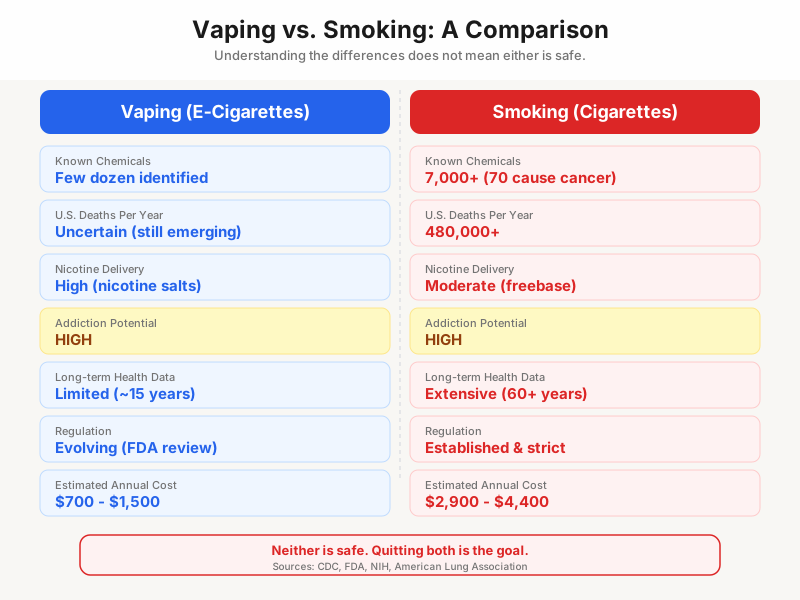 Vaping vs smoking safety comparison — Sources: Public Health England, 2022; NASEM, 2018; CDC
The Dual Use Problem
Here’s the part of the conversation that often gets lost: many people who vape also continue to smoke. This is called dual use, and it’s more common than complete switching.
Research from the Population Assessment of Tobacco and Health (PATH) Study found that a substantial proportion of vapers are dual users — smoking and vaping simultaneously. The health implications are significant:
The Bottom Line: If you smoke and vape, you’re getting most of the harm of smoking with the added nicotine of vaping. The harm reduction argument only applies if you switch completely. Even 1-2 cigarettes per day alongside vaping largely negates the potential benefit.
The Gateway Debate: Does Vaping Lead to Smoking?
This is one of the most contentious questions in tobacco control, and it’s relevant primarily for youth.
The Concern
Multiple studies have found an association between adolescent vaping and subsequent smoking initiation. A meta-analysis by Soneji et al. (2017) in JAMA Pediatrics found that e-cigarette use among youth was associated with approximately 3.5 times higher odds of subsequent cigarette smoking.
The Counterarguments
The Current Consensus
There is no settled consensus. Most researchers agree that:
Harm Reduction vs. Precautionary Principle
The vaping debate fundamentally pits two legitimate public health philosophies against each other.
The Harm Reduction Position (UK, New Zealand, Canada)
The Precautionary Position (WHO, many US health organizations)
What the Evidence Supports
Both positions have legitimate grounding. The strongest evidence-based statement would be:
For current smokers: Switching completely to regulated e-cigarettes is very likely to substantially reduce health risk. The magnitude of that reduction is debated, but the direction is not. E-cigarettes can be considered as a cessation or harm reduction tool, particularly for smokers who have failed with other methods.
For non-smokers and youth: There is no health benefit to starting to vape. The risks — nicotine addiction, potential respiratory effects, unknown long-term consequences — are all downside with no upside.
For everyone: The ideal outcome is neither smoking nor vaping. Complete cessation of all nicotine products eliminates all associated risks.
E-Cigarettes as a Cessation Tool: What Does the Evidence Say?
A Cochrane Review by Hartmann-Boyce et al. (2022) examined the evidence for e-cigarettes as cessation aids:
A landmark randomized controlled trial by Hajek et al. (2019) published in the New England Journal of Medicine found that e-cigarettes were nearly twice as effective as NRT for smoking cessation at 1 year (18% vs. 9.9%). However, 80% of successful quitters in the e-cigarette group were still vaping at the 1-year mark, raising questions about whether they’ve traded one nicotine dependency for another — albeit a less harmful one.
Practical Guidance Based on Current Evidence
If You Currently Smoke
- First-line approach: Evidence-based cessation methods (varenicline, combination NRT, bupropion + behavioral counseling) have the strongest evidence and lead to complete nicotine cessation
- If those haven’t worked: Switching completely to a regulated e-cigarette is likely to substantially reduce your health risk compared to continued smoking
- Don’t dual use. If you switch, switch completely. Cutting down cigarettes while vaping provides minimal benefit.
- Consider vaping as a bridge, not a destination. The best outcome is eventually quitting vaping too. Many people step down their nicotine concentration over time and eventually stop.
If You Currently Vape (Never Smoked)
- You are exposing yourself to nicotine dependence and inhaled chemicals with no offsetting benefit
- Quitting vaping eliminates these risks entirely
- Nicotine withdrawal from vaping follows a similar timeline to cigarette withdrawal — the same strategies and medications can help
If You’re Considering Starting
Don’t. Whether it’s cigarettes or e-cigarettes, the introduction of nicotine dependence adds risk with no health benefit. The safest option is never starting.
What We Don’t Know Yet
Scientific honesty requires acknowledging the significant gaps in our knowledge:
The honest answer to “Is vaping safe?” is: Safer than smoking, yes. Safe in absolute terms? We don’t know yet. And anyone who tells you they know the answer with certainty in either direction is outrunning the evidence.
Sources and Further Reading
- World Health Organization. “Tobacco: E-cigarettes.”