Secondhand Smoke & Vape: Protecting Your Family
Medical Disclaimer
This article is for informational purposes only and does not constitute medical advice. Always consult a healthcare professional before making changes to your health routine. If you're experiencing a medical emergency, call 911 or your local emergency number.
Read our full medical disclaimer →This Article Is Not Here to Shame You
Let me be clear about something right up front: if you’re reading this while still smoking or vaping, I’m not here to weaponize your family against you. Guilt is a terrible motivator for long-term change. It works in the short term and then it breeds resentment, secrecy, and relapse.
This article exists to give you accurate information about secondhand exposure — what it actually does, what the real risks are, and what practical steps you can take to protect the people and pets you love while you’re still in the process of quitting.
Because quitting doesn’t happen overnight. And your family shouldn’t have to wait for you to be perfect before you start protecting them.
Secondhand Smoke: The Numbers
Secondhand smoke (also called environmental tobacco smoke or passive smoke) is a mixture of the smoke from the burning end of a cigarette (sidestream smoke) and the smoke exhaled by the smoker (mainstream smoke). It contains over 7,000 chemicals, at least 70 of which are known carcinogens, according to the U.S. Surgeon General.
The Health Impact — Adults
The CDC estimates that secondhand smoke causes approximately:
These aren’t smokers. These are people who never lit a cigarette.
For partners of smokers, the data is particularly stark. A comprehensive meta-analysis in the British Medical Journal found that non-smoking spouses of smokers have a 20-30% increased risk of lung cancer and a 25-30% increased risk of heart disease.
The Health Impact — Children
Children are uniquely vulnerable to secondhand smoke because:
According to the American Academy of Pediatrics and the CDC, children exposed to secondhand smoke face increased risk of:
I include these numbers not to make you feel terrible, but because you deserve to know what you’re dealing with. Information is power. Shame is paralysis.
Thirdhand Smoke: The Invisible Residue
Thirdhand smoke is a term that emerged in the last decade, and many people still haven’t heard of it. It refers to the residual chemicals that settle on indoor surfaces after cigarette smoke has cleared.
What It Is
When you smoke indoors (or in a car), nicotine and other chemicals don’t just float in the air and disappear. They settle on walls, carpets, furniture, bedding, toys, clothes, dust, and skin. These residues react with other indoor air pollutants to create new toxic compounds, including tobacco-specific nitrosamines (TSNAs) — some of the most potent carcinogens known.
How Long It Lasts
Thirdhand smoke residue can persist for months to years after smoking stops. A study published in Tobacco Control found that homes of former smokers continued to have elevated levels of nicotine and tobacco-specific carcinogens for up to 6 months after cessation, even with regular cleaning.
The residue embeds deeply in porous materials:
Who’s Most at Risk
Babies and toddlers are at highest risk from thirdhand smoke because they crawl on contaminated surfaces, put their hands and objects in their mouths, and absorb chemicals through their skin at higher rates than adults.
A 2014 study in Environmental Health Perspectives found that infants in homes where smoking had occurred — even if adults only smoked outside — had measurable levels of tobacco-related carcinogens in their urine.
What You Can Do About Thirdhand Smoke
Secondhand Vape Aerosol: Less Harmful Is Not Harmless
Vaping produces an aerosol (commonly but inaccurately called “vapor”) that bystanders inhale. The composition is different from secondhand cigarette smoke, but it is not clean air.
What Secondhand Vape Aerosol Contains
Research published in Indoor Air and Environmental Science & Technology has identified the following in secondhand vape aerosol:
The Comparative Risk
Let’s be honest about the science: secondhand vape aerosol is significantly less harmful than secondhand cigarette smoke. The toxicant levels are generally 10-50 times lower, according to Public Health England’s evidence reviews.
But “significantly less harmful” is not “harmless,” and it’s especially not harmless for:
The long-term effects of secondhand vape exposure are unknown because vaping hasn’t existed long enough for longitudinal studies. We’re working with incomplete data, and “we don’t know yet” is not the same as “it’s fine.”
Practical Approach to Secondhand Vape
If you’re currently vaping (whether as a cessation tool or otherwise):
Protecting Your Pets
This section exists because pets are family, and they’re also uniquely vulnerable.
Dogs
Dogs exposed to secondhand smoke have higher rates of nasal and lung cancers. Breeds with longer noses (like collies and greyhounds) are particularly susceptible to nasal cancers because smoke carcinogens accumulate in their longer nasal passages. A study published in the American Journal of Epidemiology found a significant association between household smoking and canine nasal cancer.
Cats
Cats face an even more insidious risk. Because cats groom themselves constantly, they ingest thirdhand smoke residue that settles on their fur. Research from Tufts University’s School of Veterinary Medicine found that cats living with smokers have more than double the risk of developing feline lymphoma — a serious and often fatal cancer.
Birds
Birds are extremely sensitive to air quality. Their respiratory systems are highly efficient (necessary for flight) but also highly vulnerable to airborne toxins. Secondhand smoke can cause respiratory distress, feather damage, and death in pet birds.
Other Small Animals
Rabbits, guinea pigs, hamsters, and other small mammals are also affected by secondhand and thirdhand smoke, though less research exists on specific risks.
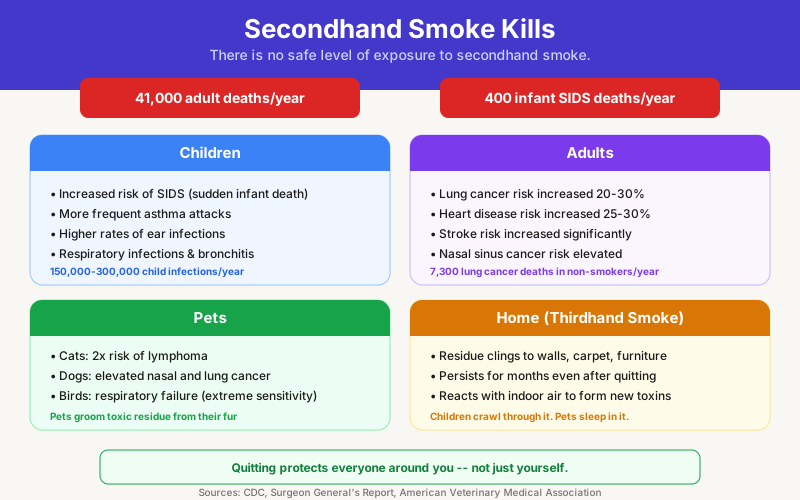 Secondhand smoke impact by group — Sources: U.S. Surgeon General, 2006; CDC; American Academy of Pediatrics
Practical Steps to Protect Your Family While You’re Still Quitting
Perfection is the enemy of protection. You don’t need to be smoke-free to start reducing your family’s exposure. Here’s what you can do right now.
The Essentials
-
Make your home completely smoke-free. This is non-negotiable if you have children or pets. Smoke outside, away from open windows and doors. Research shows that smoking in a separate room with the door closed does NOT adequately protect other occupants — smoke travels through gaps, HVAC systems, and shared air spaces.
-
Make your car completely smoke-free. Never smoke in the car, even with the windows down. A study published in Tobacco Control found that smoking one cigarette in a car — even with the window cracked — produces particulate matter levels 10 times higher than EPA indoor air quality standards.
-
Wash hands and change your shirt (at minimum) after smoking and before physical contact with children, babies, or pets. The residue on your hands and clothing is real.
-
If you vape: Follow the same indoor and car rules. The exposure is lower but not zero.
Additional Steps
Turning Protection Into Motivation (Not Guilt)
Here’s where I ask you to reframe something.
The instinct, when you read statistics about children and secondhand smoke, is guilt. And guilt is useful for about five minutes. After that, it becomes toxic — it makes you feel like a terrible parent, which makes you feel hopeless, which makes you want to smoke to cope with the feeling of being a terrible parent.
I’ve been in that spiral. It doesn’t end well.
Instead, try this reframe: protecting your family is something you can do right now, today, regardless of whether you’re ready to quit. Making your home and car smoke-free isn’t failure — it’s a concrete step. It’s taking control of what you can control while you work on the rest.
And when you are ready to quit — or even ready to try — your family becomes one of the most powerful motivations available to you. Not because of guilt, but because of love.
The CDC reports that smokers with children in the home are more likely to attempt quitting and more likely to succeed when they frame cessation in terms of family protection rather than personal health. Love works better than shame. Every time.
When Your Kids Ask About It
If your children are old enough to notice and ask questions, honesty calibrated to their age works best:
For young children (4-7): “Smoking is something that’s bad for our bodies. I’m working on stopping. That’s why I go outside — to keep the house safe for you.”
For older children (8-12): “I’m addicted to something in cigarettes called nicotine. It’s really hard to stop, but I’m trying. The most important thing is that I never smoke near you, and I want you to know that smoking is something I wish I’d never started.”
For teenagers: Be honest about the addiction. Teens respond better to authenticity than to “do as I say, not as I do.” “I started smoking when I was [age] and I regret it. Quitting is one of the hardest things I’ve done. I hope you never start.”
Research shows that parental honesty about the difficulty of addiction is more protective against teen smoking initiation than pretending the problem doesn’t exist.
The Bottom Line
Secondhand smoke kills tens of thousands of non-smokers every year. Thirdhand smoke residue exposes children and pets to carcinogens in their own homes. Secondhand vape aerosol is less harmful but not harmless.
These are facts, not accusations.
What you do with these facts is up to you. But making your home and car smoke-free, washing up after smoking, and taking practical steps to minimize exposure — these are things you can do today. They don’t require you to be perfect. They just require you to care.
And the fact that you’re reading this tells me you already do.