Nicotine Withdrawal Timeline: Day-by-Day
Medical Disclaimer
This article is for informational purposes only and does not constitute medical advice. Always consult a healthcare professional before making changes to your health routine. If you're experiencing a medical emergency, call 911 or your local emergency number.
Read our full medical disclaimer →Nicotine Withdrawal Timeline: Day-by-Day
Right now, somewhere in your brain, roughly 300 billion nicotinic acetylcholine receptors are waiting to be fed. If you’ve just quit nicotine, or you’re planning to, understanding exactly what those receptors are about to do is the single most powerful thing you can carry into this process. Withdrawal follows a predictable, well-studied pattern. It’s not random suffering. It’s a map. And when you can see the terrain ahead, the journey gets dramatically less frightening.
The Biology in 60 Seconds
Before we walk through the timeline, you need to understand one thing about what nicotine has been doing to your brain.
Every time you smoked, vaped, or used nicotine, the drug latched onto receptors called nicotinic acetylcholine receptors (nAChRs). When nicotine triggers those receptors, your brain releases a burst of dopamine, the neurotransmitter that drives reward, focus, and calm.
Here’s the problem: your brain responded to all this extra stimulation by growing more receptors. Research published in Biological Psychiatry found that chronic smokers have 25-100% more nAChRs compared to non-smokers. When you quit, all those extra receptors are screaming for nicotine that isn’t coming. Understanding how nicotine hijacks the brain’s reward system explains why the first 72 hours feel so physically relentless.
Your brain will eventually dismantle those extra receptors and return to baseline. The timeline below is that dismantling process in real time.
The First 24 Hours: The Clock Starts
Nicotine clears faster than most people realize. It has a half-life of about 2 hours, which means that roughly 2 hours after your last cigarette or vape, half the nicotine in your bloodstream is already gone.
1-4 Hours After Your Last Dose
Your liver is actively metabolizing nicotine into cotinine. Blood nicotine levels are declining measurably. Your brain’s reward system is noticing something is missing but hasn’t fully sounded the alarm yet.
What you’ll feel: mild restlessness, background irritability, a pull to reach for something. For most people this is still manageable. Don’t be fooled into thinking it stays this quiet.
6-12 Hours
By the 12-hour mark, carbon monoxide levels in your blood have dropped back to normal if you were smoking combustible cigarettes. Blood oxygen levels are rising. Your body is already healing, but your brain is getting louder.
Cravings arrive in waves. Anxiety or low-grade irritability is common. Some people notice headaches starting around the 8-hour mark as blood vessels begin to dilate.
The Bottom Line: The first 12 hours are uncomfortable but manageable. Carbon monoxide is clearing, oxygen is rising. The real challenge hasn’t started yet.
12-24 Hours
By the 24-hour mark, your body has cleared most of the nicotine itself, though cotinine, its metabolite, lingers for days. This is when your brain’s alarm bells go from whisper to shout.
If you smoked combustible cigarettes, your risk of heart attack has already begun to decrease within these first 24 hours, according to the American Heart Association. Your body moves fast when you give it the opening.
Days 2-3: The Peak
This is the summit. If withdrawal were a mountain, days 2 and 3 would be the steep, rocky scramble before the view. Push through here and everything after gets easier.
Day 2
Nicotine is now essentially gone from your body. Your brain’s excess receptors are firing without their agonist, and the neurochemical chaos peaks. A study published in Psychopharmacology found that withdrawal symptoms reach maximum intensity approximately 48-72 hours after cessation.
Expect intense cravings, difficulty concentrating, irritability, sleep disruption, and possible nausea or headaches. These are normal, and they are not permanent.
Day 3
The absolute peak for most people. Concentration is roughest here. Mood is at its lowest. But here’s what you need to know: it’s already getting better by the end of day 3. The peak is also the turning point.
Your brain is beginning receptor downregulation: those excess nAChRs are starting to be pruned back. Research from the National Institute on Drug Abuse shows that while this process takes weeks to complete, the most acute neurochemical disruption happens right here at days 2-3.
The Bottom Line: Days 2-3 are the hardest. Full stop. If you can get through these 48 hours, every day after gets progressively easier. That’s what the neuroscience shows, not motivation.
Days 4-7: The Downslope Begins
Most people notice a shift on day 4. The physical symptoms begin to ease. Cravings are still present but start to lose their sharp edge.
Day 4
You might wake up and notice it’s slightly less terrible than yesterday. That’s not wishful thinking — it’s your receptor downregulation actually working. Sleep often improves slightly. Concentration starts returning. Appetite changes continue but become more predictable.
Days 5-7
By the end of the first week, most of the acute physical withdrawal is behind you. A landmark study by Hughes (2007) in Nicotine & Tobacco Research tracked withdrawal symptoms and found that the majority of physical symptoms decline significantly after the first week.
For context on what individual cravings feel like during this stretch, see how long nicotine cravings last. The answer surprises most people.
The Bottom Line: Week 1 is the physical gauntlet. By day 7, roughly 85% of the acute physical withdrawal is behind you. What remains is increasingly psychological, driven by habits and associations, not raw neurochemistry.
Weeks 2-4: The Rewiring Period
This is where people get caught off guard. The physical symptoms have largely faded, but psychological withdrawal becomes more prominent. You’re not craving nicotine the chemical as much as you’re craving the ritual.
Week 2
The morning cigarette with coffee. The smoke break that marked the end of a meeting. The post-meal habit. These aren’t chemical cravings anymore. They’re conditioned responses, and they can feel just as urgent as the day-2 stuff.
Marcus Webb, a 43-year-old mechanic from Columbus who quit after 22 years of a pack-a-day habit, described week two like this: “I wasn’t climbing the walls like day 3. But I kept reaching for something that wasn’t there. It was like phantom limb syndrome for smoking.” He used the patch through week four and said that dampening the edge made the ritual-breaking feel survivable.
Weeks 3-4
By the end of the first month, receptor downregulation is well underway. Research using PET brain scans published in Archives of General Psychiatry showed that nAChR availability begins normalizing within 4 weeks of quitting and can approach non-smoker levels by 6-12 weeks.
Some people experience a temporary dip in mood around weeks 3-4 as their dopamine system calibrates without nicotine’s artificial boost. If it feels severe or persistent, see managing depression and anxiety during your quit.
Months 2-3: The New Normal Emerges
Month 2 is when something quietly shifts. You start to have entire stretches of the day, sometimes hours, where you don’t think about nicotine at all. The cravings that do come are more like echoes than demands.
Month 2
Cravings are less frequent. When they show up, they’re shorter. Sleep has likely normalized. Most weight changes have plateaued. Energy levels are typically better than when you were smoking, even if that’s hard to remember right now.
Month 3
For most people, the active withdrawal phase is essentially over by the end of month 3. Your brain’s receptor density is approaching non-smoker levels. Your dopamine system is functioning independently again.
The Bottom Line: By month 3, you’ve completed the neurobiological withdrawal. Your brain has physically restructured itself closer to a non-smoker’s brain. What remains are learned associations, habits that fade with continued exposure to triggers without relapsing.
Months 4-12: Consolidation and Occasional Echoes
The withdrawal is over. What you’ll experience in this phase aren’t withdrawal symptoms. They’re cue-induced cravings, moments when an environmental trigger reactivates an old neural pathway. Think of it like a trail through the forest: the path exists, but if you stop walking it, it eventually grows over.
What to Expect
Cravings in this phase are infrequent and brief. Most ex-smokers describe them as a passing thought rather than an urgent pull. Common triggers are stress, alcohol, social situations where others are smoking, and specific times of day that used to be tied to the habit. Each craving lasts 3-5 minutes, then it’s gone.
The main risk in this phase isn’t day-to-day urges. It’s a high-stress event that lowers your guard at the exact moment you stop thinking of yourself as someone who has to be careful. Have a response plan ready for those moments before they arrive.
The Extinction Learning Process
Your brain learns by association. The more times you encounter a trigger (morning coffee, work stress, seeing someone smoke) without following it with nicotine, the weaker that association becomes. Neuroscientists call this extinction learning. Each craving you ride out without giving in literally weakens the neural circuit that produced it.
Research by Conklin et al. (2008) in Addiction demonstrated that cue-induced cravings decrease significantly over the first year, with the steepest decline in the first 3 months.
The Long View: 1-5 Years
By 12 months, most ex-smokers report that they rarely think about smoking. Cravings, when they happen, are mild and fleeting. Your brain has essentially completed its remodeling project.
But the health benefits keep compounding long after the cravings stop. At one year, coronary heart disease risk drops to roughly half that of a current smoker. At five years, stroke risk falls to that of a non-smoker. At ten years, lung cancer risk is cut in half relative to someone who kept lighting up. These are tracked outcomes from decades of follow-up data in the Surgeon General’s report and American Heart Association research.
A small percentage of ex-smokers report very occasional cravings even years later, often in moments of extreme stress or when encountering highly specific triggers. These are remnants of deeply encoded memory, not active withdrawal — and they pass in seconds.
Factors That Affect Your Personal Timeline
Not everyone’s withdrawal follows the same schedule. Several factors influence your experience:
| Factor | Effect on Timeline |
|---|---|
| Daily consumption | Heavier users typically experience more intense acute symptoms |
| Years of use | Longer history means more deeply encoded habit associations |
| Use of NRT or medication | Reduces acute symptom severity and craving intensity significantly |
| Mental health history | Anxiety or depression can intensify psychological symptoms in weeks 2-4 |
| Nicotine metabolism (CYP2A6 gene) | Faster metabolizers often feel cravings more sharply and sooner |
| Current stress level | High chronic stress slows the psychological rewiring period |
If you’re using a nicotine patch or other NRT, your acute symptoms will be less severe because you’re stepping down your nicotine intake rather than cutting it completely. The timeline is compressed, not eliminated.
Practical Strategies Mapped to the Timeline
Days 1-3 (The Peak)
Start NRT from day one if that’s your plan. Don’t wait for the craving to spike before putting the patch on. Tell one person you trust that today is day 1 — social accountability is a real, measurable tool. Avoid alcohol entirely for these first 72 hours; it lowers inhibitions at exactly the wrong time and is one of the strongest relapse triggers there is. Drink more water than you think you need. Cravings and dehydration overlap more often than most people realize.
Days 4-14 (The Decline)
Replace the ritual, not just the substance. What used to happen at your morning-cigarette time? Create something else for that slot. Track your cravings for 3 days: when they hit, what you were doing, how long they lasted. Most people are surprised by how brief they are. A 10-minute walk temporarily elevates dopamine and blunts cravings more reliably than sitting through the discomfort.
Weeks 3-12 (The Rewiring)
Identify your specific triggers and build a response plan for each one before you hit it. If you drink, know that alcohol at week 5 is different from week 1 — your guard is down and nostalgic associations run strong. Consider a cessation counselor or the quit line (1-800-QUIT-NOW) if this phase still feels like white-knuckling. Professional support meaningfully improves long-term outcomes, and using it isn’t a sign that you’re doing it wrong.
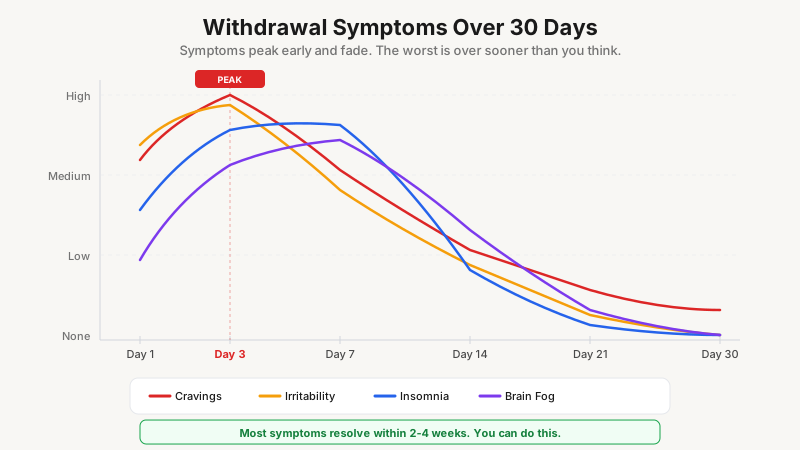 Nicotine withdrawal symptom intensity over 30 days. Sources: Hughes, 2007, Nicotine & Tobacco Research; National Institute on Drug Abuse
The Numbers That Should Give You Confidence
| Milestone | When It Happens | Source |
|---|---|---|
| Heart rate and blood pressure begin dropping | 20 minutes after last cigarette | American Heart Association |
| Carbon monoxide clears from blood | 12 hours | CDC |
| Peak craving intensity | 48-72 hours | Psychopharmacology, 2007 |
| Individual craving duration | 3-5 minutes | NIDA |
| Lung function improves up to 30% | 2 weeks to 3 months | American Lung Association |
| Coronary heart disease risk halved | 1 year | American Heart Association |
| Stroke risk reaches non-smoker level | 5-15 years | Surgeon General’s Report |
| Lung cancer risk halved vs. continuing smokers | 10 years | Surgeon General’s Report |
These aren’t distant abstractions. Each one starts the moment you put down your last cigarette. The body doesn’t wait for an invitation to start healing.
Sources and Further Reading
- Hughes, J.R. (2007). “Effects of abstinence from tobacco: Etiology, animal models, epidemiology, phenomenology, and measurement.” Nicotine & Tobacco Research, 9(3), 329-339.
- Benowitz, N.L. (2010). “Nicotine Addiction.” New England Journal of Medicine, 362, 2295-2303.
- Conklin, C.A. et al. (2008). “Proximal versus distal cues to smoke.” Addiction, 103(10), 1697-1706.
- Breese, C.R. et al. (1997). “Effect of smoking history on [3H]nicotine binding in human postmortem brain.” Journal of Pharmacology and Experimental Therapeutics, 282(1), 7-13.
- National Institute on Drug Abuse. “Tobacco, Nicotine, and E-Cigarettes Research Report.” drugabuse.gov.
- American Heart Association. “Smoking and Cardiovascular Disease.” heart.org.