How to Quit Smoking: Complete Guide
Medical Disclaimer
This article is for informational purposes only and does not constitute medical advice. Always consult a healthcare professional before making changes to your health routine. If you're experiencing a medical emergency, call 911 or your local emergency number.
Read our full medical disclaimer →You’re here because something inside you wants to change. Maybe you’ve tried before and it didn’t stick. Maybe this is your very first time thinking seriously about putting down the cigarettes. Either way, you’re in the right place — and the fact that you’re reading this right now? That already matters more than you know.
Quitting smoking is one of the hardest things you’ll ever do. Let’s not sugarcoat it. Nicotine is one of the most addictive substances on the planet, and cigarettes are specifically engineered to deliver it as efficiently as possible. According to the CDC, fewer than 1 in 10 adults who try to quit each year succeed on their first attempt. But here’s the other side of that coin: tens of millions of people have quit successfully, and the overwhelming majority of them failed at least once before it finally stuck.
This guide is your roadmap. We’ll walk through everything — why you smoke, how to prepare, the methods that actually work, how to survive the first brutal week, and how to stay smoke-free for good.
Why Do You Smoke? (Understanding the Enemy)
Before you can beat this thing, you need to understand what you’re up against. Smoking isn’t just a “bad habit” — it’s a three-headed dragon: physical addiction, psychological dependence, and behavioral routine.
The Physical Hook
Nicotine reaches your brain within 10 seconds of inhaling. It triggers a release of dopamine — the same feel-good chemical that fires when you eat your favorite food or get a hug from someone you love. Your brain starts to associate cigarettes with pleasure and relief. Over time, it builds more and more nicotine receptors, demanding bigger and more frequent doses just to feel normal. That’s physical addiction in a nutshell.
The Psychological Grip
You’ve taught your brain that cigarettes are the answer to everything. Stressed? Smoke. Bored? Smoke. Celebrating? Smoke. Grieving? Smoke. This is conditioned association, and it’s powerful. Research published in the Journal of Abnormal Psychology shows that smokers genuinely believe cigarettes reduce stress — even though studies consistently demonstrate that smoking actually increases baseline anxiety levels over time.
The Behavioral Habit
Then there’s the ritual. The hand-to-mouth motion. The walk outside. The after-dinner cigarette. The smoke break with coworkers. These routines are deeply embedded in your daily life, and they can feel as hard to break as the nicotine itself.
Understanding all three of these forces is key. Because a quit plan that only addresses one of them is setting you up to fail.
Preparing to Quit: Your Pre-Quit Checklist
The most successful quit attempts don’t happen on impulse. Research from the National Institutes of Health shows that smokers who prepare and plan before their quit date are significantly more likely to succeed. Here’s how to set yourself up for the best possible shot.
Set a Quit Date
Pick a date within the next two weeks. Far enough away that you can prepare, close enough that you stay motivated. Some people pick a meaningful date — a birthday, an anniversary, New Year’s Day. Others just pick next Tuesday. What matters is that you commit to it.
Build Your Quit Plan
A quit plan is your personal playbook. It should include:
- Your reasons for quitting — write them down and keep them where you’ll see them
- Your triggers — the situations, emotions, and routines that make you reach for a cigarette
- Your strategy — which method you’ll use (more on that below)
- Your support system — the people who will cheer you on
- Your emergency plan — what you’ll do when a craving hits hard
Tell People
This might feel uncomfortable, but telling your friends, family, and coworkers that you’re quitting does two important things: it creates accountability, and it lets the people around you know to be supportive (and maybe not offer you a cigarette at the next cookout).
Talk to Your Doctor
Your doctor can prescribe medications, recommend NRT products, and connect you with counseling resources. A study published in the Cochrane Database of Systematic Reviews found that combining medication with behavioral support increases quit rates by 70-100% compared to going it alone.
Stock Up on Supplies
Depending on your approach, this might include nicotine patches, gum, lozenges, hard candy, straws, toothpicks, healthy snacks, a stress ball, or a new water bottle. Prepare your environment before quit day arrives.
Choosing Your Method: What Actually Works
There’s no single “best” way to quit. The best method is the one you’ll actually follow through on. That said, some approaches have a significantly better track record than others.
Nicotine Replacement Therapy (NRT)
NRT works by giving your body nicotine without the tar, carbon monoxide, and 7,000+ chemicals in cigarette smoke. Options include:
- Patches — steady, all-day nicotine delivery; great for baseline cravings
- Gum — chew-and-park method for acute cravings; available in 2mg and 4mg
- Lozenges — dissolve in your mouth; good alternative if you don’t like gum
- Nasal spray — prescription only; fastest-acting NRT option
- Inhaler — prescription only; mimics the hand-to-mouth ritual
The CDC reports that NRT increases your chances of successfully quitting by 50-70%. You can buy patches, gum, and lozenges over the counter without a prescription.
Prescription Medications
- Varenicline (Chantix) — blocks nicotine receptors and reduces cravings; widely considered the most effective single quit-smoking medication
- Bupropion (Zyban/Wellbutrin) — an antidepressant that also reduces cravings and withdrawal symptoms
Both require a prescription and a conversation with your doctor about potential side effects.
Cold Turkey
About 90% of quit attempts happen without medication or NRT, and roughly 5-7% of those succeed long-term. Those aren’t great odds, but some people do it. If you’re considering cold turkey, pair it with strong behavioral strategies and support.
Behavioral Counseling
Individual counseling, group therapy, and telephone quitlines all improve your chances. Call 1-800-QUIT-NOW (1-800-784-8669) for free coaching — it’s available in all 50 states and connects you with trained counselors who’ve helped thousands of people quit.
Combination Therapy
Here’s the gold standard: combine NRT (or medication) with behavioral counseling. The American Cancer Society calls this the most effective approach available. You’re addressing the physical addiction and the psychological patterns at the same time.
Quit Day: Your Game Plan
You’ve prepared. The day is here. Let’s do this.
The Morning
- Remove all cigarettes, lighters, and ashtrays from your home, car, and workspace
- Put on your nicotine patch or have your NRT ready
- Eat a solid breakfast — blood sugar drops can mimic nicotine cravings
- Remind yourself why you’re doing this
When Cravings Hit
Cravings typically last 3-5 minutes. That’s it. They feel like they’ll last forever, but they won’t. When one comes:
- Delay — tell yourself “I’ll wait 10 minutes” (the craving will usually pass)
- Deep breathe — inhale for 4 counts, hold for 4, exhale for 4
- Drink water — slowly, deliberately; it occupies your mouth and hands
- Do something — walk, stretch, call a friend, chew gum, squeeze a stress ball
- Remind yourself — pull out your list of reasons for quitting
Avoid Your Triggers
If you always smoke after dinner, get up and take a walk instead. If you smoke when you drink, skip the bar this week. If your smoke break is with coworkers, take your break somewhere else. The first few days are about avoiding as many triggers as possible while your brain adjusts.
The First Week: Survival Mode
Let’s be real — the first week is rough. Your body is going through nicotine withdrawal, and it doesn’t feel good. But knowing what to expect makes it so much more manageable.
What You’ll Feel
- Days 1-3: The worst of it. Irritability, anxiety, difficulty concentrating, increased appetite, strong cravings. This is peak withdrawal.
- Days 4-7: Symptoms begin to ease. Cravings are still there but less intense. You might feel foggy or tired. Mood swings are common.
How to Get Through It
- Stay hydrated — water flushes nicotine out of your system faster
- Move your body — even a 10-minute walk releases endorphins and reduces cravings
- Sleep — your body is healing; give it rest
- Eat regular meals — keep blood sugar stable to avoid craving spikes
- Be patient with yourself — you’re doing something incredibly hard, and you’re allowed to be grumpy about it
Remember: Every craving you resist makes the next one weaker. You’re literally retraining your brain right now.
Weeks 2-4: Building Momentum
The acute withdrawal symptoms are fading. You’re sleeping better. Food tastes incredible (seriously, you’ll be amazed). You can smell things again — sometimes that’s wonderful, sometimes… less so.
This is where the psychological battle takes center stage. The physical cravings are weakening, but the habit triggers are still there. Your brain still expects a cigarette after meals, during your commute, and when you’re stressed.
Strategies for This Phase
- Develop new routines — replace the cigarette with something else: a walk, a piece of fruit, a few minutes of a phone game, a breathing exercise
- Track your wins — use a quit-smoking app or a simple calendar to mark each smoke-free day
- Reward yourself — take the money you’re saving and spend it on something you enjoy
- Stay connected — keep talking to your support people; don’t isolate
Long-Term Maintenance: Staying Smoke-Free for Good
Congratulations — you’ve made it past the hardest part. But quitting isn’t a one-time event; it’s an ongoing commitment. Here’s how to protect your progress.
Know Your High-Risk Moments
Even months or years later, certain situations can trigger surprisingly strong cravings: a major life stress, a night of heavy drinking, a nostalgic moment, or being around other smokers. Have a plan for these moments before they arrive.
Build Your Smoke-Free Identity
You’re not a “smoker who’s trying to quit.” You’re a non-smoker. That shift in identity matters more than you might think. Research from the University of Exeter found that people who adopted a non-smoker identity were significantly more likely to maintain long-term abstinence.
If You Slip
A slip is not a failure. If you have one cigarette after three weeks smoke-free, that doesn’t erase 21 days of progress. What matters is what you do next. Throw away the pack. Recommit immediately. Figure out what triggered the slip and adjust your plan.
The average successful quitter tries 6-11 times before quitting for good. Every attempt teaches you something. Every attempt makes the next one more likely to succeed.
The Payoff: What Your Body Does After You Quit
This is the part that keeps you going when it gets hard:
- 20 minutes — heart rate and blood pressure drop
- 12 hours — carbon monoxide levels in your blood return to normal
- 2 weeks to 3 months — circulation and lung function improve
- 1 to 9 months — coughing and shortness of breath decrease
- 1 year — heart disease risk drops to half that of a smoker
- 5 years — stroke risk drops to that of a non-smoker
- 10 years — lung cancer risk drops to about half that of a smoker
- 15 years — heart disease risk equals that of someone who never smoked
These numbers come directly from the American Cancer Society, and they’re real. Your body starts healing the moment you stop.
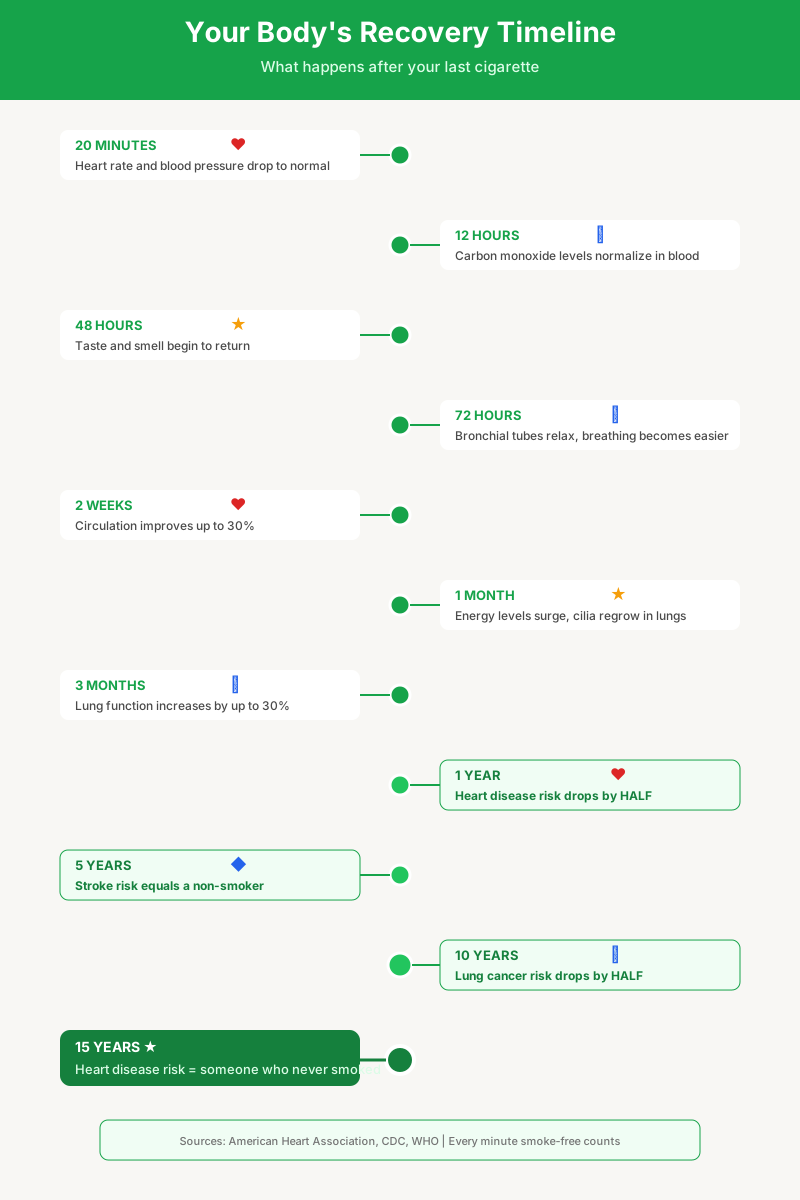 Your body’s recovery timeline after quitting — Sources: American Cancer Society; American Heart Association; CDC
Free Resources to Help You Quit
You don’t have to do this alone. These resources are free, confidential, and available right now:
- 1-800-QUIT-NOW (1-800-784-8669) — free coaching, all 50 states
- Smokefree.gov — quit plans, text programs, apps, and live chat
- SmokefreeTXT — text QUIT to 47848 for daily tips and encouragement
- Your state quitline — many offer free NRT (patches, gum, lozenges)
- BeTobaccoFree.gov — federal resources and campaign information
You’ve Got This
Look, quitting smoking is not easy. Anyone who tells you otherwise has never done it. But millions of people — people who were every bit as addicted as you are right now — have done it and stayed smoke-free. They’re not superhuman. They just decided, prepared, got help, and kept going even when it was hard.
You don’t need to be perfect. You just need to be persistent. Every smoke-free hour is a victory. Every craving you ride out makes you stronger. And every morning you wake up without that heaviness in your chest is proof that it’s working.
You’ve already taken the first step by reading this guide. Now take the next one. Set your quit date. Tell someone you love. Call 1-800-QUIT-NOW. And know that on the other side of this struggle is a life where you breathe easier, taste food again, save thousands of dollars a year, and take back control from a little paper tube that’s been running your life for too long.
You’ve got this.